Tuesday, 31 March 2015

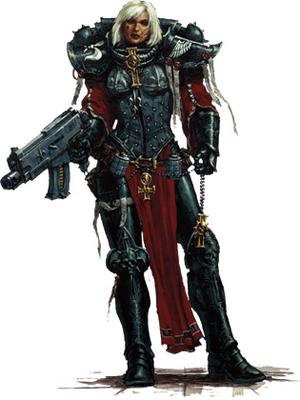
Codex Sisters of Battle : Frateris Militia


Recently I've spent a while looking through the Sisters of Battle Codex, as well as rereading the novels Faith and Fire and Hammer and Anvil. As a result I've been pondering the Sisters range of available units and have come to the conclusion that I find their current roster somewhat limited, both with regards to the tabletop and the fluff. This in turn has led me to come up with some new units for the Sororitas, both to increase the diversity of their army and to fill a number of empty niches in their arsenal.

The first of these units is not technically a new one, rather its a unit that has been established in the fluff for a long time and that used to be available to the Sisters of Battle in previous codices. This is my attempt to re-introduce them under the current editions rules.

--------------------

Frateris Militia :
Though the Ecclesiarchy is banned by the Degree Passive from maintaining a large force of "Men Under Arms", a ruling handily sidestepped by the Sisters of Battle, faithful imperial citizens are still allowed to take up weapons under the banner of the Ecclesiarchy should they see fit to do so. These warbands commonly form when a War of Faith is announced or when a planets faithful arm themselves in response to an outside threat, in both cases usually disbanding once the immediate crisis is over. Some bands however are standing forces in their own right, usually dedicated to a specific task such as defending a particular pilgrim route, shrine or other place of importance to the Imperial Faith.

Frateris Militia are usually poorly trained, disciplined and equipped, taking to the battlefield in great hordes of shouting, screaming fanatics hurling themselves at the enemy uncaring of such niceties as ammunition conservation, cover, or tactics. Some however are drawn from the ranks of men and women who once served in the Imperial Guard or PDF, these veterans either taking up command positions amongst their brethren or forming into highly effective fighting units of warrior pilgrims. No matter their composition however these warbands will follow the commands of the highest ranking Priest or Battle Sister present, trusting them to guide the Militia in how best they can serve the God Emperor of Mankind.

Some especially devout Militia will willingly throw themselves in front of the enemy guns in order to protect the beloved Priests and Sisters from harm. Others will strap themselves with crude, homemade explosives and charge into the midst of the foe, screaming prayers even as they detonate their payloads and martyr themselves in blasts of purifying flame. Amongst the most fanatical of the Frateris are the bands of flagellants, usually men and women driven insane by loss and religious fervour, who mortify their bodies with blades, hooks, and great flails which they will turn on the enemy with righteous glee.

Frateris Militia Squad (Troops) : 20pts


WS BS   S   T  W   I   A LD SV
Frateris Militia / Martyr     2    2     3     3     1     3     1     6     - 
Frateris Battle Pilgrim   3   3   3   3   1   3   1   7  5+
Flagellant   3   2   3   3   1   3   1   8   -

Unit Composition : 10 Frateris Militia
Unit Type : Infantry
Wargear :
  • Frateris Militia : Lasgun, Close Combat Weapon
  • Frateris Battle Pilgrim : Lasgun, Close Combat Weapon, Flak Armour, Frag Grenades
  • Martyr : Close Combat Weapon
  • Flagellant : Two Close Combat Weapons
Special Rules :
  • Martyr : Willing Martyrdom
  • Flagellant :  Crusader, Zealot
Options : 
  • May include up to 20 additional Militia : 2pts per model.
  • May replace Lasguns with Laspistols : Free.
  • May replace Lasguns with Shotguns : 1pt per model.
  • May replace Close Combat Weapons with Heavy Close Combat Weapons : 2pts per model.
  • Upgrade 1 or more Frateris Militia to Frateris Battle Pilgrims : 3pts per model .
  • Upgrade all Frateris Militia to Martyrs : 1pt per model.
  • Upgrade all Frateris Militia to Flagellants : 3pts per model.
  • For every 10 Frateris Battle Pilgrims in the unit one may take an item from the Special Weapons list.
  • For every 10 Martyrs in the unit one may take a Martyrs Harness : 10pts.*
  • For every 10 Flagellants in the unit one may take an Eviscerator : 30pts
*Before Deployment the owning player must decide if the harness is Explosive or Incendiary.

Special Rules and Equipment : 

Heavy Close Combat Weapon (Weapon) : The more fanatical Militia commonly arm themselves with oversized melee weapons, axes, hammer, flails, and anything else they can get their hands on or cobble together.

Heavy Close Combat Weapon, Range : Melee, Strength : User +2, AP : -, Special Rules : Two Handed.

Martyrs Harness (Wargear) : These are little more than heavy vests or coats with as many crudely made explosives or incendiaries as possible sewn or stuffed into pouches or pockets, all wired together to a single detonator.

During the Assault Phase a model with a Martyrs Harness may choose to detonate it instead of making their melee attacks. If they do so a shooting attack is immediately resolved using one of the two profiles shown below, with the blast template placed touching the harness equipped models base. Once the attack has been resolved the model equipped with the harness is removed as a casualty.

Martyrs Harness (Explosive) : Range : Melee, Strength : 6, AP : 3, Special : Blast
Martyrs Harness (Incendiary) : Range : Melee, Strength : 5, AP 4, Special : Blast, Ignores Cover

Willing Martyrdom (Special Rule) : Some Frateris are so devout that they willingly make of themselves a shield, protecting the faithful from harm with their own flesh and bone.

Friendly units may freely fire through this unit, though their targets will benefit from a 5+ cover save for being fired at through a unit. Additionally if an enemy unit fires at a friendly unit obscured by a unit with this special rule the friendly unit gains a +1 bonus to their cover save. Each time a successful cover save is made due to this units presence one model is immediately removed from it with no roll to wound required or armour save allowed.

Design Notes : The Frateris Militia have existed in the fluff for as long as the Adepta Sororitas, not only that but the concept of a horde of fanatics hurling themselves against the enemy and screaming prayers to the God Emperor even as they're cut down is both an evocative part of the universe as well as a stark contrast to the far more controlled and professional Sisters. On the battlefield this unit gives the Sororitas access to large and expendable units of infantry to protect the more valuable Sisters as well as cheap units to be used for area denial, objective control, and bogging down powerful enemies.

--------------------

I'd just like to say that this post has in no way been influenced by the recent launch of Raging Heroes latest kickstarter... no, no not at all. Of course I haven't pledged to it...no of course not...

Seriously, go check it out. Raging Heroes produce some of the most beautiful models I've ever seen and the range released for their last Kickstarter was amazing. They're more than worth your time and money to support if you're a fan of beautifully sculpted female models.

Sales pitch ends here.

As far as additional units go, here is a quick overview of the ones currently percolating around inside my head...
  • Elohim : Melee focussed Seraphim, battle sisters with Jet Packs armed with deadly mono-spears and power weapons.
  • Lay Technomats : Faithful who have been trained by the heretics of Mars to repair and maintain the Sisters of Battle's weapons, armour and vehicles.
  • Repentant Psykers : Psykers who's powers have been hobbled and subverted so that their mere presence inhibits the use of Warpcraft.
  • And more! Including a possible Centurion / Terminator equivalent....
As a final word, once again if my readers have any thoughts or comments on these units feel free to comment and let me know what you think. I'd love to hear any feedback, especially if any of you wonderful people feel like converting and using any of them.

Until Next Time
Happy Gaming
Michael

Friday, 20 March 2015

In Memoriam : Terry Pratchett

As I'm sure those of you that read this blog are aware, last week one of the worlds most beloved fantasy authors, Sir Terry Pratchett, passed away after a long struggle with early onset Alzheimers disease. To me this was particularly upsetting, not due to any personal link to Sir Terry, but due to the impact that his writing has had on my life.

The Discworld books were some of the first fantasy / science fiction novels I read in my youth, after branching out from J.R.R Tolkein, David Eddings, Frank Herbert and the like. I started with Feet of Clay, which I remember being bought for me whilst on a family holiday in some god forsaken corner of Wales, and I was immediately hooked. The affectionately cynical mockery and deconstruction of common fantasy tropes, the wry study of human nature, the surprising depth and wit of his writing, as well as the sheer damned quality it, all combined to instil in me a life long love for the man's work.

I can honestly attribute to my reading of Terry's work my love of exploring fantasy, not just of reading it but of examining it, taking it apart, deconstructing and reconstructing it to see what makes it tick. Likewise my love of building worlds, of creating stories, of taking ideas, throwing them at a literary wall and seeing what does and what does not stick were fanned to life by his books. It's also helped to make me more of a student of human nature, though admittedly in a somewhat cynical fashion. I'm sure he would have approved.

It is one of my deepest regrets that I never met him, if I had the chance I would simply have liked to shake his hand and say "Thank you, for everything."

To quote his official Twitter account regarding his death...

"AT LAST, SIR TERRY, WE MUST WALK TOGETHER.

Terry took Death's arm and followed him through the doors and on to the black desert under the endless night.

The End."

For a generation of fans, it very much is. Though as he wrote himself in Going Postal "A man is not dead while his name is still spoken."

Until Next Time
Michael

Saturday, 30 August 2014

Dungeons and Dragons 5th Edition : First Impressions


So, its finally here. Having had a few nights to flick through the new Players Handbook and digest what I've come across (as well as make up a few characters, some new, some rewrites of old favourites), here are my first impressions...

After the unmitigated catastrophe that was D&D 4th Edition (in my not so humble opinion anyway) I can safely say that expectations were... low. Now, don't get me wrong, 4th Edition had some good ideas, but it also had a lot of bad ones too, and it just didn't FEEL like D&D. It felt (and played) more like a boardgame, or a tabletop version of World of Warcraft than an actual RPG. Needless to say a large number of players, myself included, either stuck with D&D 3.5 or moved on to Pathfinder rather than switch to what they saw as the "kiddy" version of their game.

Can 5th Edition win me back? Well, the answer to that question is a resounding... maybe! Here we go...

The Fluff :

I don't have much to say about the background at the moment, mostly because there isn't much of it in the book. Which you'd expect really, it's a rulebook, not a campaign setting. That said I've got to say that it feels good to get back to The Forgotten Realms, to Greyhawk, to Dragonlance, even to the relative newcomer of the group Eberron. I've a lot of fondness for these worlds (the first three mainly, but I do quite like Eberron) and it pleases me that all three of them are mentioned in the players handbook, along with lists of deities and short extracts from published novels set in Toril, Krynn etc.

Having all the settings unified by a single set of rules right from the start is a great way to not only unify the settings and establish a core set of rules across the board but also to titillate geeks like me who love crossovers and the like. Come on Wizards, you KNOW you want to start republishing Spelljammer...

Seriously, do it. I will buy and play the SHIT out of it if you do.

That said I do have one or two little niggles, the main one being the art. Some of the art in the book is absolutely wonderful, some of it is absolute garbage. For example compare the illustration of the Sorcerer on page 99, which is excellent, to the race art for the Halfling on page 26, which is terrible. Wizards of the Coast really have no excuse for bad art considering some of the talent they have access to.

My other main niggle is entirely a personal one. Some of the characters depicted in the book are famous ones from novels and settings, for example the Character Creation example character is Bruenor Battlehammer of Dragonlance fame. The race art for the Elf? Drizzt Do Fucking Urden. Is it just me or should a sample character be representative of their race as a whole? Or at least the most common conceptions thereof? Bruenor is an archetypal dwarf, surly, proud, and fiercely loyal to his friends. Drizzt on the other hand is an anomaly, an aberration, a renegade and most definitely NOT a typical Drow, or even a typical Elf! Its not as if there weren't plenty of other Elves they could have used instead, Laurana Kanan for example?

Yes, this is an entirely personal and irrational quibble. I'm not going to apologise for it.

The Crunch :

Moving on... overall the rules of the game are considerably simplified, and strangely remind me strongly of 1st and 2nd edition D&D as much as they do the more recent editions. The main change to the core mechanics is that almost everything is based around Ability Score tests instead of Skill Checks, Saving Throws and BAB based Attack Rolls. For example, when caught by a Fireball instead of making a Reflex Saving Throw a character will instead make a Dexterity Saving Throw.

The other major change is to how exactly characters get better at these checks and tests. Instead of each class having a Base Attack Bonus, Saving Throws and Skill Points that increase at variable rates they instead have a list of Proficiencies and a Proficiency Bonus. These proficiencies can be Armour, Weapons, Skills, Saves or Tools, whilst the bonus increases at a set rate dependant on the characters overall level. These bonuses can either apply to checks or can be used to set the Difficulty Class for checks made by others.

Example 1 : When making an attack roll with a melee weapon a player rolls a good old D20, adds their characters Strength Bonus, and if said character is proficient with whatever weapon they're using, their Proficiency Bonus. If they aren't proficient, they simply roll 1D20 and add their strength bonus. A level 8 Fighter with a Strength Score of 18 would roll 1d20+7 (+3 Proficiency Bonus, +4 Strength Bonus).
Example 2 :  When casting a spell that allows a saving throw the Save DC is 8 plus the spellcasters Proficiency Bonus, plus the appropriate Ability Score Modifier. A level 15 Wizard with an Intelligence Score of 20 would have a Save DC of 18 (8 base, +5 Proficiency Bonus, +5 Intelligence Bonus).

I like this, its reminiscent of other Attribute based systems such as the various 40k Roleplay games. Its a robust and versatile way of dealing with the challenges thrown at a party, and lends itself to adaptation in the hands of a clever DM or players. There are numerous other changes to the rules of course, here are some of the main changes that have caught my eye...
  • Advantages / Disadvantages : Instead of granting bonuses to checks or ability scores most spells and effects instead grant an Advantage or Disadvantage. Mechanically this allows a character to roll the D20 for a test twice, and take the highest result. For example the Enhance Ability spell (which replaces Bears Endurance, Bulls Strength etc.) grants an Advantage to checks based on one ability score for the duration of the spell.
  • Ability Scores : Ability scores work the same way they do in 3.5/Pathfinder, with the interesting caveat they they're capped at 20 for player characters. Additionally all characters gain a +2 bonus to an ability score of their choice (or a +1 bonus to two different ability scores) every 4 levels, meaning that a character will cap out their most important ability scores pretty quickly.
  • Class Archetypes : Each class has two or more Archetypes, chosen within the first few levels. In addition to Wizard Schools, Sorcerer Bloodlines and Cleric Domains Barbarians choose a Primal Path, Bards a College, Monks a Monastic Tradition and so on and so forth. This is a nice idea, and includes some very interesting options. For example a Fighter can choose from Champion (simply becoming a better combatant), Battlemaster (gaining access to special combat manoeuvres), or Eldritch Knight (augmenting their combat abilities with  limited spellcasting).
  • Feats : Feats are both optional and highly limited. Instead of taking an Ability Score improvement a character may choose a feat instead, which though less numerous are also considerably more powerful, in some cases granting an Ability Score bonus in addition to the feats benefits. For example the Great Weapon Fighter feat essentially combines Power Attack and Cleave, allowing a character with it to make an extra attack after dropping a foe, and giving them the option to take a -5 penalty to an Attack Roll in exchange for a +10 bonus to their damage.
  • Skills : Skills have been massively stripped out and simplified. Skill checks are simply based around a D20 roll plus the characters Ability Score and Proficiency bonuses. Rather than having an extensive section for each skill with its uses, bonuses and penalties each instead has a brief overview of what can be done with it. This is one of the things I'm worried about as it strips a lot of depth from the different skills. On a related note Craft skills no longer exist, instead characters can be proficient with a particular set of Tools, allowing them to craft items using them. Whilst I'm on the subject Characters do not have to increase in level to gain proficiency with a particular type of tool (or to learn a new language, instead they can simply spend some time and gold learning to use that particular set of tools or to speak that language. I really like this, and wish more systems allowed for advancement / proficiency independent of character level. 
  • Resting :  4th Edition introduced the idea of using Long and Short rests to allow characters to recover their Hit Points and ability uses. 5th Edition continues this tradition with characters able to take a Short Rest (lasting an hour) or a Long Rest (lasting 8 hours) to regain hit points and regain their Spell Slots and ability uses, though the exact benefits of resting vary somewhat from class to class.
  • Spellcasting : Spellcasting has changed dramatically. Each primary spellcasting classes spells per day have been greatly reduced, with characters no longer gaining additional spells per day based on high ability scores and even the mightiest magic users only having a single 9th level spell slot per day. To make up for this spells are generally more powerful, with Cantrips having been massively buffed and spells no longer having a caster level, instead if a character wants their spell to be more effective they use a higher level slot to cast it. For example the spell Firebolt is a 0 level cantrip that deals 1d10 damage on a successful Magic Attack Roll, increasing to 4d10 by 17th level. Meanwhile Fireball is a 3rd level spell that deals 8d6 fire damage, 9d6 if cast using a 4th level spell slot, 10d6 if cast using a 5th level spell slot and so on. Overall it seems that spellcasters will use their "per day" slots less often, with their cantrips allowing them to consistently contribute to the adventure even when their spell slots have been expended. I was also pleased to discover than no character class has to prepare their spells in advance any more. With even Clerics and Wizards instead selecting a number of Spells Known per day equal to their Character Level + their Spellcasting Ability Score and then using their spell slots in the same manner as a 3rd edition Sorcerer.
I could go on for some time outlining every single change to the rules, but I don't have the time or inclination. If what I've said so far interests you then I'd advise you to pick up the Players Handbook and give it a look for yourself, if nothing else its an interesting read.

Conclusion :

Overall the game has been simplified considerably, whilst still remaining a sufficient level of complexity to keep it interesting. The mechanics seem to have been streamlined with the intention of speeding gameplay, something I can wholeheartedly support considering how long combat can take in Pathfinder and the like, especially with newer or casual players who don't have the encyclopaedic rules knowledge of long time veterans. Versatility also seems to be the order of the day, with DM's and Players alike encouraged to play around with the rules a little more in interesting ways. Finally there also seems to be an overall drop in power overall for player characters, with there being far less disparity in ability between high and low level characters.

Overall its an interesting update to a 40 year old game, and one that's piqued my curiousity enough to get me to give it a whirl. I will however be withholding judgement until I've actually had a chance to play. Needless to say I'll be sharing my thoughts once I've done so.

Until Next Time
Happy Gaming
Michael

Tuesday, 19 August 2014

Deadzone : Review


So recently I've been playing Deadzone from Mantic Games. Though I picked up my copy of the special edition way back in...ohh...march I think, Ive only actually started playing it in the last two weeks, and overall Im slightly annoyed that I didn't give it a go earlier as its quite a lot of fun.

Overview :

Deadzone is a miniature skirmish game originally funded through Kickstarter and published by Mantic Games, known for their lines of affordable fantasy and science fiction models as well as the science fiction sports game Dreadball and board games such as Dwarf Kings Hold and Project Pandora. The game is notable for its use of a small (2ft by 2ft) half rubberised gaming mat alongside customisable clip together plastic buildings meant to represent prefabricated colony structures and the like. There's still a LOT to be released for this game, looking at the Kickstarter unlocks, but I've only had experience of the “Wave 1” releases so far. Lets crack on shall we?

The Fluff :

Deadzone shares the same science fiction setting as Mantics games Warpath, Dreadball and Project Pandora. This being a dystopian future where humanity is united under the rule of the monolithic Corporation and its overseeing Council of Seven, with alien races and colony worlds subjugated for their resources and technology by the Corporations overwhelming millitary and technological advantages. Alongside humanity a number of alien races are present, some of whom owe a fair chunk of their inspiration to existing franchises (namely the Forgefathers and Orx to Warhammer 40k's Squats and Orks, and The Plague to Halo's Flood and Dead Space's Necromorphs), though admittedly with their own interesting twists, whilst others are pretty darn original (such as the newly released Asterians and the various races allied with the Rebs).

More specifically the game is set in one of the eponymous “Deadzones”, planets or solar systems that the Corporation has temporarily (or permanently) taken off the grid and blockaded for whatever reason, be it an uprising, viral outbreak, alien incursion, whatever. Such Deadzones are enforced by the Enforcers, fanatically loyal elite infantry equipped with the best weapons and armour available to the Corporation's armed forces as well as their own starships, supply chains and so on and so forth. Other factions commonly found in the Deadzones are...

  • The Orx Marauders, a race of Space Orcs who in contrast to their usual depictions in fiction are highly disciplined and well equipped mercenaries and opportunists, with more in common with Spelljammers Scro than Warhamer 40k's Orks. They're commonly employed to fight for the Corporation but also operate in independent forces when it suits them to do so.
  • The Rebs, a ragtag alliance of human and alien rebels (in case the name didn't tip you off) against the rule of the Corporation and the Council of Seven.
  • The Plague, a common cause for the creation of Deadzones. These dangerous and violent lifeforms are created by a multi stage infection caused by mysterious alien artifacts. Think Necromorphs, save that the weakest variants are still capable of using technology, like guns.... and spaceships... yeah...
  • The Forgefathers, the Space Dwarf counterpart to the Marauders Space Orcs. A highly technologically advanced race who are one of the few nonhuman species not under the thumb of the Corporation, due both to their technology and their strong millitary forces.
  • The Asterians, a mysterious race who's Deadzone forces are composed of cyborgs and remotely controlled robots. They are the glass cannon to the Forgefathers mighty glacier and according to the Kickstarter posts they are the only existing race who understand the origins of the Plague.

Whilst the setting has some interesting ideas and factions it's not especially detailed as of yet, something that Im very much hoping that Mantic rectify as the years go by. I for one think that theres a lot of room for them to expand and elaborate on what they've started, as well as there being the potential for numerous additional games set in the same universe. A ship combat game featuring Enforcer and Corporation warships enforcing Deadzone Blockades in the face of infected and ramshackle Plague vessels for example?

The Crunch :

The Deadzone boxed set comes with models for two of the above factions, the Enforcers and the Plague, both of whom I have now played. I'm planning to pick up some of the other factions in the future and will possibly do a faction by faction overview at some point, time permitting. Now, I'm not going to go into a detailed rundown of how the game works, if you're that interested then check out the Mantic website or see if any game shops nearby are running demo's. Instead I'll run through the mechanics that distinguish the game from its competitors and my thoughts thereupon.

The Deadzone battlefield is split into an eight by eight grid of cubes (the rulebook is careful to note that these are CUBES, not squares). These are used for determining the limits and effects of terrain as well as for all in game measurement, movement, shooting, area of effect weapons, etc. Each cube can contain a set number of models, with larger models taking up a greater number of model "slots" in each cube. This is an interesting mechanic, as well as making measurement much simpler (and eliminating pedantry over whether that model is within the requisite quarter of an inch or not) it also speeds gameplay considerably and ensures that the extent of all buildings, effects and so on are very clearly defined.

Dice rolls are resolved using a pool of three dice rolled against a target number, with each die that rolls that number or higher producing a success in a similar fashion to OWoD. Each models Shoot, Fight and Survive statistics determine the required target number, with lower being better, with special equipment, cover, injuries and the like adding additional dice to or removing dice from the pool. This is the first time I've seen this system used in a wargame and it works well, especially considering that the rulebook sections for each Action that requires dice to be rolled includes all the appropriate modifiers for that test in a single location. I cannot overstate how useful that is.

Now this is an interesting mechanic. Models have an "Aggression" state, ranging from Enraged to Suppressed, with them taking bonuses and penalties depending on which state they're in. Enraged models have their shooting penalised but their melee attacks augmented, Suppressed models benefit more from cover but suffer badly in melee, that kind of thing. Models Aggression states most commonly change due to being hit by a Blaze Away action (suppressive fire) which if successful causes them to drop towards Suppressed, or due to taking the Get Mean action which raises their aggression towards Enraged.

Deadzone uses an incredibly simple damage system. Models are unharmed, injured, or dead, thats all. There's no tracking of Wounds / Hit Points / Hull Points, no locational damage, nothing. Actually inflicting damage on a model can be surprisingly difficult at times, most models in the game seem pretty durable with concentrated fire being needed to ensure the target drops.

The game uses a slightly modified "Alternate Activation" system for turn progression, similar to Malifaux. However instead of players alternating models they may instead activate a set number of models at a time. The number of models activated being determined by their force leaders Command statistic, making these models especially important as if they are eliminated then the model with the next highest Command statistic takes over, to the almost certain detriment of your strike force.

Finally the game comes with a deck of Battle Cards, serving two purposes in game. Firstly each of the cards in the deck has two possible effects printed on it, such as granting additional movement actions, giving bonuses to dice rolls, or preventing an opponents model from activating for a round. Secondly the deck serves as a turn counter of sorts, with the game ending once one of the players battle decks has been exhausted. Importantly the number of cards each player draws per turn is determined by the Command statistic of their strike force leader, once again these models are particularly important... and equally valuable targets.

All of the above mechanics seem designed to ensure that the game moves quickly, that the rules and boundaries are clearly defined, and that the mechanics are easy to understand but retain sufficient complexity to keep the game sufficiently interesting to more experienced gamers. All very laudable in a skirmish game. Interesting mechanics aside however I've a few minor issues with the games manual and model stat cards. Namely that certain cards have rules on them that are not in the rulebook, notably the Enforcer Defender's Defender Shield. I understand that what's available so far is only the first wave, but still it wouldn't have taken any appreciable effort to make sure that all the rules for what's in your starter box are actually in the rulebook. Likewise some of the models who's stat cards are in the box aren't even available to purchase, such as the aforementioned Enforcer Defender as well as the Enforcer Medic. This is just... strange.

The Miniatures :

As already mentioned the Deadzone box comes with a pile of models for both the Enforcers and the Plague. As is the standard for Mantic these models, whilst not the highest quality available, are perfectly serviceable and with a bit of care look pretty darn good. The Enforcers have some excellent, dynamic poses as opposed to the standard “holding rifle across chest” stance far too common to firearm equipped models, whilst the Plage 1A and 2A models look suitably monstrous and dangerous, though the 3A's are rather...oddly proportioned with enormous chests and shoulders. The only real issues I have with the models are that they're not especially easy to assemble, requiring some filing to make sure the parts fit properly. Likewise they're made of plastic resin that doesnt take superglue as well as either normal model plastic or resin for some strange reason.

The clip together terrain is crisp, durable, looks good when properly assembled.... and is anything but clip together. Despite being touted as a modular terrain system that you can take apart and rebuild whenever you want the lack of sufficient connector parts as well as the slight inconsistencies in slot size make this impractical. I will instead be deciding on a specific set of terrain builds and gluing them together. That way I can paint them properly without worrying about inconstistencies when reassembled, as well as not having to concern myself with my buildings falling apart during a battle, as happened during my second game. I laud the idea, the execution however is sadly somewhat lacking.

Conclusion :

Overall Deadzone is a fun little skirmish game that you can play in an hour or less, the small mat and the clip together terrain make both game setup and packing away quick and easy, and its not so complicated as to be overwelming whilst simultaneously having enough depth to be interesting. If you've some cash spare and fancy trying out a new skirmish wargame then I heartily recommend it despite the handful of quality issues that I've mentioned over the course of this review. Issues that I hope Mantic will deal with in the future. Theres some good ideas here, fluffwise, crunchwise and modelwise.

Now, what colour scheme should I use for Enforcer Strike Force Thanatos 72/14/Omega, aka The Deadboys...

Until Next Time
Happy Gaming
Michael